Showing posts with label equipment. Show all posts

Friday, May 29, 2009

Nikon D90 - Early Thoughts

1946 Mercury 1/2 Ton Truck taken at 1/2000, f/4.8 and ISO 800

I recently sold my Nikon D80 to a friend and replaced it with the new Nikon D90. I haven't had a lot of time to play with it yet, but I wanted to get a few pictures and a video posted. Yes...a video, the Nikon D90 takes HD video in addition to fabulous pictures. Last Sunday morning, I spent a few hours at the Bar U Ranch, south of Longview, taking photos and trying out some of the new features of this camera.

While at the ranch, I came across this character who had two beautiful old trucks on display. The first, is the two-tone custom 1946 Mercury 1/2 ton, pictured above, built on a Camero chassis with a Camero engine. The other truck, below, is a 1947 Mercury and is rebuilt in stock condition.

1947 Mercury 1/2 Ton Truck taken at 1/2000 s, f /4.0, and ISO 800
Looking at old vehicles, talking with this guy and taking photos was a great way to spend a morning. Just before I left, I came across a blacksmith demonstrating how to make horseshoes, so I decided to try out the video feature on the new camera. This video was taken hand-held with my Nikon 18-200 lens. It gives you an idea of what camera can do.


Taking video with the D90 is going to take some getting used to. The video feature has several pros and cons. The pros are; camera and video in one unit, being able to take HD video with awesome Nikon lenses and a shallow depth of field. The cons are; no auto-focus in video mode, a tripod is almost essential, sound quality is just OK. It is pretty cool however to be able to take HD video clips with a digital SLR. I'll post more on the video features in a later post.

My initial impression of the D90 is... I love it. As I've said before, I like the D80/D90 form factor because it is a full-featured digital SLR in a very small and portable body. The D90 has inherited lots of features from the D300 including an improved sensor with much improved noise suppression over the D80. I've lamented in previous posts that my rejection rates with istockphoto were creaping up because of the noise levels with my D80. I'm looking forward to submitting some of my pics from the D90 and see if they get accepted.

Thursday, February 19, 2009

Basketball Photography

18-200 mm lens set to 18 mm, 1/80 sec at f/3.5, ISO 250

It's basketball season so I've spent the last couple of months attending my son's basketball games and trying to figure out how those amazing Sports Illustrated photogs ply their craft. Taking photos of fast-moving action in poorly lit gyms is a definite challenge and does require some specialized equipment. Here's how I did it on a shoestring budget. First of all, I'm a huge fan of David Hobby and his Strobist site. His site is my number one source of information for "off camera" lighting. Over the past year I've purchased two used Nikon speedlights (SB-24 & SB-28) from eBay and a Cactus V2 wireless transmitter and two receivers. I also use lots of gaffers tape and bongo ties. The biggest challenge that I've found is getting enough light on the subject so that I can use a reasonably low ISO with a fast enough shutter speed to stop the action.

The setup:
I like to use my 50 mm f/1.4 lens as it allows me to get close to the action while still using a large enough aperture to blur the background. I've also experimented with my 18-200 mm VR lens, but with less success. In order to provide adequate light I attached the radio trigger receivers to each flash and then used bongo ties to attach one speedlight to the railing of the bleachers, pointing towards the top of the key. The second flash was set up on the opposite side of the
gym in a similar position, but without a railing to fasten it to, I had to use gaffer's tape to fasten it to the wall. Not ideal but it worked. I did get some pretty funny looks from some of the parents in the crowd. Using this setup, and the radio transmitter attached to the camera I was able to get both flashes to fire simultaneously and stop the action on the floor. Even though I had the lighting pretty much sorted out didn't mean it was easy to get great shots. To get really great action shots you need to take lots of photos and spend lots of time practicing in order to get to the point where you can anticipate the action. My respect for the SI guys is huge.

Wednesday, February 11, 2009

Fast 50


My favorite lens, and one that every photographer should have in their arsenal, is a "fast 50." When I bought my digital SLR camera I said no to the temptation of an inexpensive "kit" lens and instead put the money into a 50 mm f/1.4, which cost about $400. Even if you can't afford the f/1.4, you can get a 50 mm f/1.8, which will work just fine, for $140.

Two reasons why you need a "fast 50." First, we all find ourselves in low light situations where a zoom lens, like my 18-200 mm VR f/3.5-5.6, just won't cut it. This past summer when we were in Ireland, we attended the Willie Clancy Traditional Music Festival.
During the day students attend clinics and in the evening all of the pubs fill with musicians and spectators for "sessions." In the dimly lit pubs, by cranking my ISO up to 800 and my aperture on my 50 mm lens opened up to f/ 1.4 to 2.0, I was able to capture some decent images. These photos wouldn't ever be accepted on iStock, but I'm very glad I have these images captured.

The second reason that the "fast 50" is a must have lens, is because it gives the photographer the ability to use a very shallow depth of field and throw the background into a soft creamy blur. This technique really makes the subject seperate and stand out from the background. If you don't have a "fast 50", this is the next piece of gear to add to your kit.

Wednesday, February 4, 2009

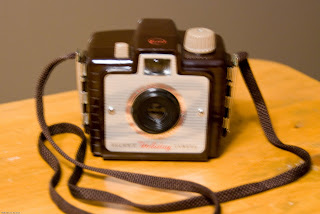
We've Come A Long Way Brownie

Astronomical Clock (1410) Prague, Czech Republic


I just bought a new camera! It wasn't expensive, just 20 bucks on eBay, but to me it's a pretty special find. My new camera is exactly the same as my very first camera, the Kodak Brownie Holiday Camera, which I have referred to in earlier posts. It is pretty low-tech and doesn't have any settings, other than a winding knob and the shutter release. It consists of a brown bake-lite plastic light-proof box with a viewfinder and a shutter. I received my new camera in the mail today and was pleased to find that it is in almost mint condition. 

As I was admiring my new (vintage) camera and thinking about how much cameras have changed in recent years, I thought that I would use my new camera to demonstrate the effectiveness of the vibration reduction (VR) technology found in many new lenses. Just as a point of interest, "VR" is a Nikon term while Canon uses the "IS" (Image Stabilization) designation for their comparable technology. When I first started researching the Nikkor 18-200 mm VR lens, I was skeptical of the claims that people were making about VR lenses. Nikon claims that photographers can shoot at a full two stops slower shutter speed than with a non-VR lens. A general rule of thumb for shutter speed is that the inverse of the shutter speed should be greater than the focal length of the lens that you are shooting with. What this means in practical terms is if you are shooting at 65 mm, you should be shooting at a minimum of 1/60 th of a second in order to minimize camera shake and blur. I am absolutely amazed at the actual results of this lens. The above photo was shot hand-held at 65 mm, ISO 400, f/5.0 at 1/3rd of a second

This second photo was taken with exactly the same settings, but with the VR feature turned off. Click on each image to see a larger photo. I think the results of my demonstration clearly show the effectiveness of VR technology. The top image is not exactly "tack sharp" but it is usable. The second photo is definitely a reject. 

Does VR make my tripod obsolete? Definitely not. But when I am travelling light and want to maximize mobility, VR is a credible alternative. When we were in Dublin and Dresden last summer, we saw signs in several of the old cathedrals stating that tripods were not even allowed inside. VR allowed me to capture several photos in dim light conditions that would otherwise not have been possible like image of the astronomical clock taken on a dark and drizzly day in Prague, Czech Republic last July. 

As always, I appreciate and value your comments. I'd love to read your thoughts about VR or IS technology or your memories of your first camera. 

Friday, January 23, 2009

My Gear Pt. I


Let me begin by quoting Scott Bourne from This Week in Photography, "Nobody makes bad lenses or bad cameras anymore." That being said, I researched my camera gear very carefully before I purchased it in the fall of 2007. My decisions were based on the fact that we would be traveling to Europe in the summer of 2008, and I wanted to travel light. I also wanted to maximize the quality of equipment for the least amount of money (which is always more than you've budgeted when you are buying camera gear). I spent considerable time in camera stores, handling cameras from both Canon and Nikon. I didn't consider other manufacturers as I wanted to be able to access the large number of used lenses, speedlights, and other accessories available. I settled on the Nikon D80 because I really liked the way it fit my hands and the controls were intuitive to operate. My next decision after deciding on the D80 body was what lens to buy. I was tempted to purchase the inexpensive "kit" lens, but decided instead on purchasing the best glass I could afford. I settled on the Nikkor 50 mm f/1.4 and have been very happy with this compact, very fast and high quality lens.
I especially like the shallow depth of field that is achieved by shooting with a large aperture, resulting in a smooth, silky background. Whenever I purchase a new lens I also buy a high quality UV filter which protects the front element of the lens from dust and scratches.
I spent the next few months taking hundreds of photos with my new system, getting to know the controls, options, and settings. I found this combination of camera body and lens to be excellent for many types of photography, but found myself getting frustrated with not being able to "bring in" many subjects because of the short focal length. I knew that I would soon be looking for a longer focal length zoom lens. While I was saving up for my next lens I purchased several additional memory cards, an extra battery, and a remote shutter release so that I could take long exposure photographs with the camera mounted on a tripod.
In November of 2008 I began shopping for a zoom lens that would cover a decent range and still be compact and high quality. I did lots of research and after much consideration chose the Nikon 18-200 f/3.5-5.6 VR lens. I really like this lens. I've taken about 90% of my photos with this lens and it is as close to an "all-in-one" that you could hope to get. Having the full range of focal lengths from wide-angle to moderate zoom in one lens does not come without some sacrifice in sharpness, speed and minor darkening of the corners at 28 mm. With this pair of lenses, the 18-200 mm and the fast 50 mm I was almost set for travel photography.
To round out my gear I acquired a good quality circular polarizing filter to fit the 18-200 and a 120 GB Hyperdrive Colorspace, which is a portable hard drive with a screen and built in card reader. This device was perfect for storing my digital photos so that I could clear off my cards and keep shooting. This particular model is quite reasonably priced and the internal rechargeable battery can be charged with a USB cable, AC adapter, and a car charger. I also took along a second portable hard drive which I used to backup the Hyperdrive whenever I had access to a computer.
My last purchase before our trip was a good quality camera backpack. I looked at several LowePro bags but I wasn't happy with the quality of the stitching and velcro closures. I tried out one bag in a local camera store and as I opened a velcro tab, the stitching let loose. Not impressed. I ended up choosing the Customary Barge backpack from Crumpler. I like this bag because it looks like a regular backpack instead of a camera bag. The bottom half has storage for a SLR camera, an extra lens and some accessories. The top portion has enough room for my rain gear and odds and ends. It also has a full padded sleeve for a laptop which can accomodate my Toshiba Tecra laptop. About a month after I bought my backpack, I stepped on one of the buckles for the waist belt and broke it. I sent the good folks at Crumpler an email and they sent me a free replacement waist belt. I was very impressed with their customer service.

 
Custom Search